Clinical Education
Diode Laser vs. IPL
Not all light-based hair removal is equal. Understanding the technical differences between diode laser and IPL helps you choose a platform that delivers real, permanent results — safely, across every skin type.
The Technology
What is a Diode Laser?
A diode laser generates a single, coherent wavelength of light — typically 808nm for hair removal. Because the beam is monochromatic and collimated, nearly all energy travels directly to the melanin in the hair follicle without scattering in surrounding tissue.
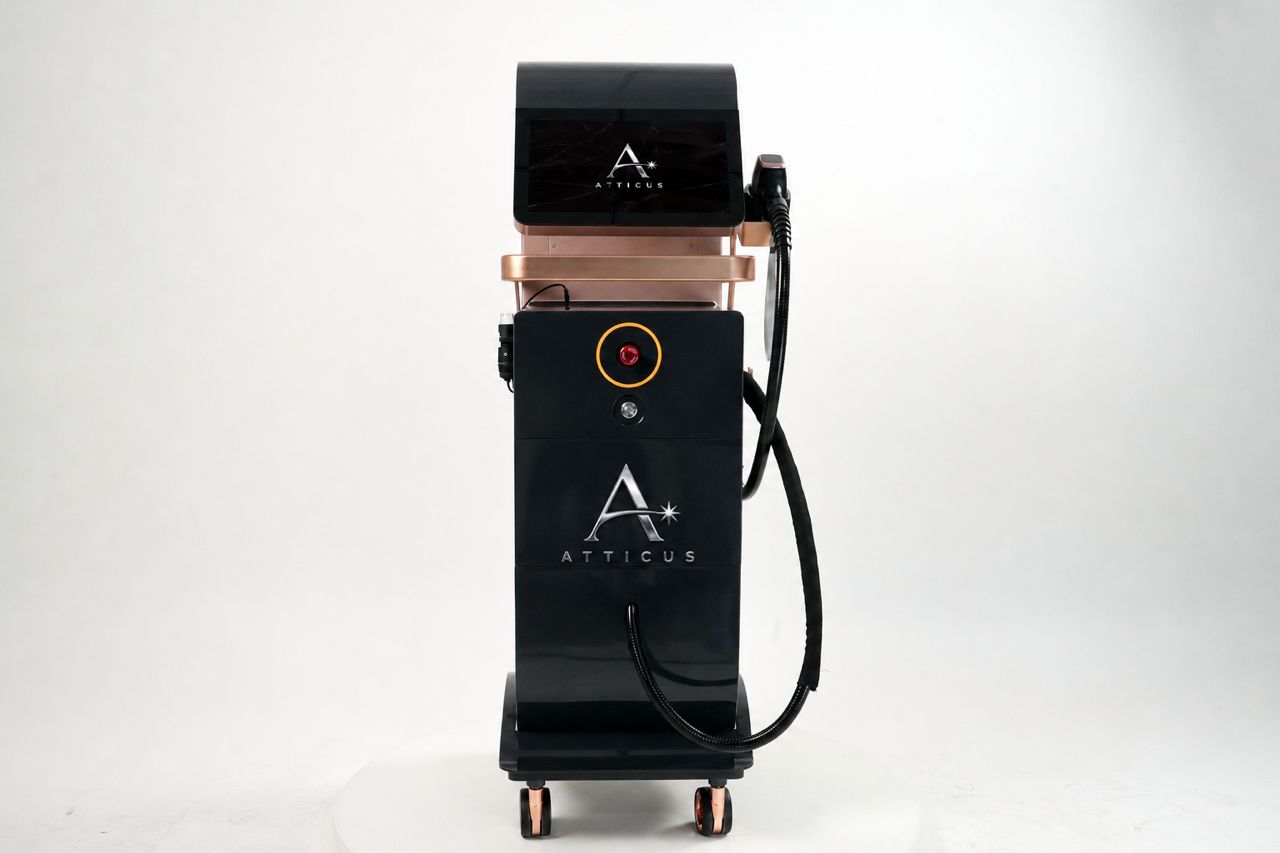
Advanced platforms like Atticus Diode Pro add 755nm and 1064nm wavelengths, giving practitioners a precise tool for every Fitzpatrick type and hair depth.
The Technology
What is IPL?
IPL (Intense Pulsed Light) uses a broad-spectrum flash lamp that emits light across a wide range of wavelengths — often 500–1200nm. Cut-off filters narrow the band, but the light remains non-coherent and divergent.
Much of the energy is absorbed by hemoglobin, water, and surface melanin before reaching the follicle, which is why IPL typically requires more sessions and delivers less permanent reduction.
Side-by-Side
How They Compare
The table below breaks down the technical and clinical differences that matter most to practitioners and business owners choosing a hair removal platform.
| Feature | Diode Laser | IPL | Advantage |
|---|---|---|---|
| Light Source | Coherent, monochromatic laser beam — one precise wavelength targets the follicle directly. | Broad-spectrum flash lamp (multiple wavelengths) — scatters energy across skin and hair. | diode |
| Wavelength Precision | Single, stable wavelength (e.g., 808nm) with optional multi-wavelength platforms like 755/808/1064nm. | Broadband 500–1200nm — only a fraction reaches the intended chromophore. | diode |
| Follicle Targeting | Laser energy concentrates at the follicle base for thermal destruction with minimal scatter. | Energy disperses across skin layers; more passes required for equivalent follicle damage. | diode |
| Skin Safety & Comfort | Advanced contact cooling (down to −3°C) protects epidermis during high-energy delivery. | Gel cooling or air cooling only; higher risk of surface heating and discomfort. | diode |
| Treatment Speed | Large spot sizes + high repetition rates enable rapid full-body sessions. | Smaller effective spot sizes and lower fluence require more treatment time per area. | diode |
| Suitable Skin Types | Triple-wavelength systems (755/808/1064nm) safely treat Fitzpatrick I–VI. | Best on light skin + dark hair. High melanin absorption increases burn risk on darker skin. | diode |
| Result Permanence | Clinical studies show 80–90% permanent hair reduction after a completed protocol. | Typically 60–70% reduction; more maintenance sessions needed long-term. | diode |
Clinical-Caliber Results
Why Atticus Diode Pro Outperforms IPL
Atticus is not simply a "better diode laser." It is a platform engineered to close the gap between salon-grade IPL and clinical-scale systems — delivering outcomes that match med-spa standards at a scale independent businesses can operate.
Triple-Wavelength Architecture
Atticus Diode Pro combines 755nm, 808nm, and 1064nm in one platform. 755nm targets fine, light hair; 808nm is the universal gold standard; 1064nm penetrates deeply for darker skin tones and coarse roots. IPL cannot switch wavelengths — it is stuck with a fixed filter set.
−3°C Contact Cooling
The Atticus handpiece maintains continuous −3°C contact cooling for up to 5 seconds. This protects the epidermis while allowing higher fluence at the follicle. IPL systems rely on pre-applied gel or passive air cooling, which cannot match real-time thermal control.
Smart Follicle Detection
Integrated skin-reading sensors auto-adjust energy density based on hair density and skin type. This reduces operator guesswork and minimizes adverse events. IPL lacks real-time feedback — settings are manual and static.
1600W Handle Output
Atticus handpieces deliver 1600W of stable diode output — substantially above the 50–100W common in entry-tier IPL and diode handles. Higher peak power means fewer passes, shorter appointments, and better client throughput.
When to Choose What
Is IPL Ever the Right Choice?
IPL has a place in aesthetics — primarily for photorejuvenation(treating pigmentation, vascular lesions, and general skin tone). Its broad spectrum is an asset for surface-level skin concerns.
However, for permanent hair reduction, the physics favor laser. If your business model depends on delivering reliable, repeatable hair removal outcomes across diverse client demographics, a triple-wavelength diode platform is the clinically supported choice.
Bottom line: IPL is a generalist. Diode laser is a specialist. When hair removal is your revenue driver, you need the specialist.
Common Questions
Diode Laser vs. IPL: FAQ
Is diode laser better than IPL for hair removal?
Yes — for permanent hair reduction, diode laser is clinically superior. Its monochromatic wavelength targets the follicle precisely with minimal scatter, while IPL's broad spectrum spreads energy across skin layers. Studies show diode lasers achieve 80–90% permanent reduction vs. 60–70% for IPL, with fewer sessions required.
Does diode laser work on dark skin?
Modern triple-wavelength diode platforms like Atticus Diode Pro include a 1064nm wavelength specifically designed for darker skin tones (Fitzpatrick IV–VI). The 1064nm wavelength bypasses surface melanin and penetrates deeply to the follicle, minimizing burn risk while maintaining efficacy.
Is IPL hair removal permanent?
IPL typically delivers temporary to semi-permanent hair reduction. Because the energy is less concentrated at the follicle, regrowth is more common and maintenance sessions are needed more frequently. For clients seeking long-term results, diode laser is the recommended technology.
What is the best laser for hair removal?
The "best" laser depends on the client population, but a triple-wavelength diode platformis the most versatile clinical choice. By combining 755nm, 808nm, and 1064nm, one device can safely and effectively treat every skin type and hair depth — eliminating the need for multiple machines.
Why do med spas prefer diode lasers over IPL?
Med spas prioritize efficacy, safety, and client satisfaction. Diode lasers deliver faster, more permanent results with less discomfort. Advanced contact cooling and higher power output allow practitioners to treat more clients per day with greater confidence and fewer adverse events.
Ready to Compare in Person?
See the Atticus Diode Pro Difference
Schedule a demo with your regional Atticus representative and experience triple-wavelength precision, −3°C contact cooling, and smart follicle detection firsthand.